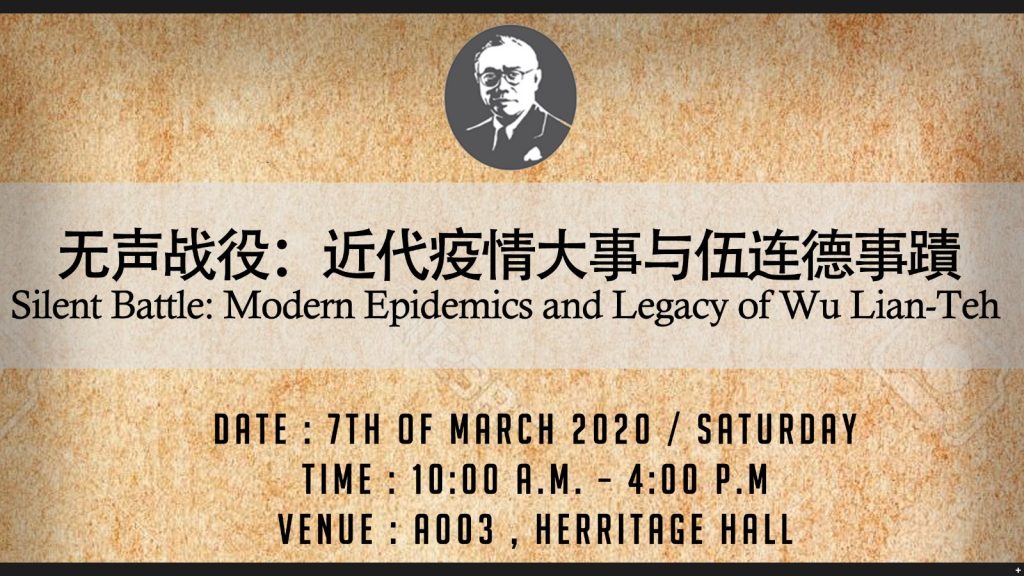
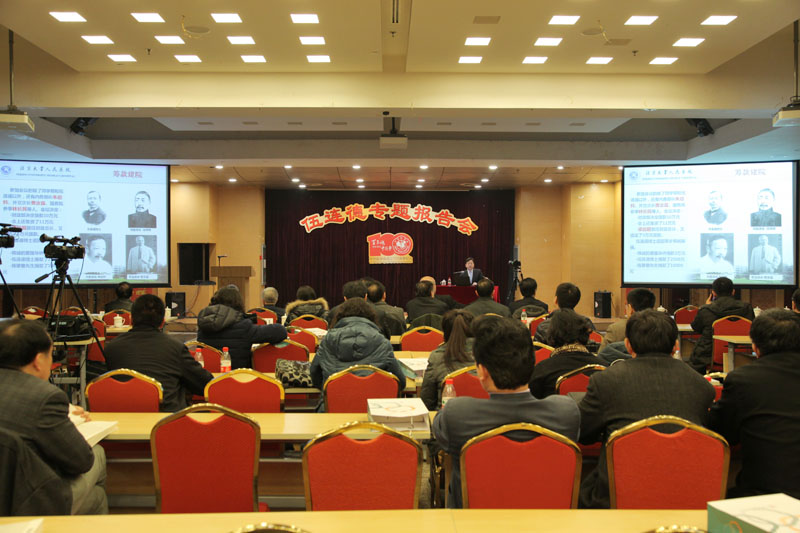
A public seminar organised by the Centre for Chinese Studies and World History Club, Tunku Abdul Rahman University (UTAR) on 7th March 2020, Heritage Hall, UTAR.
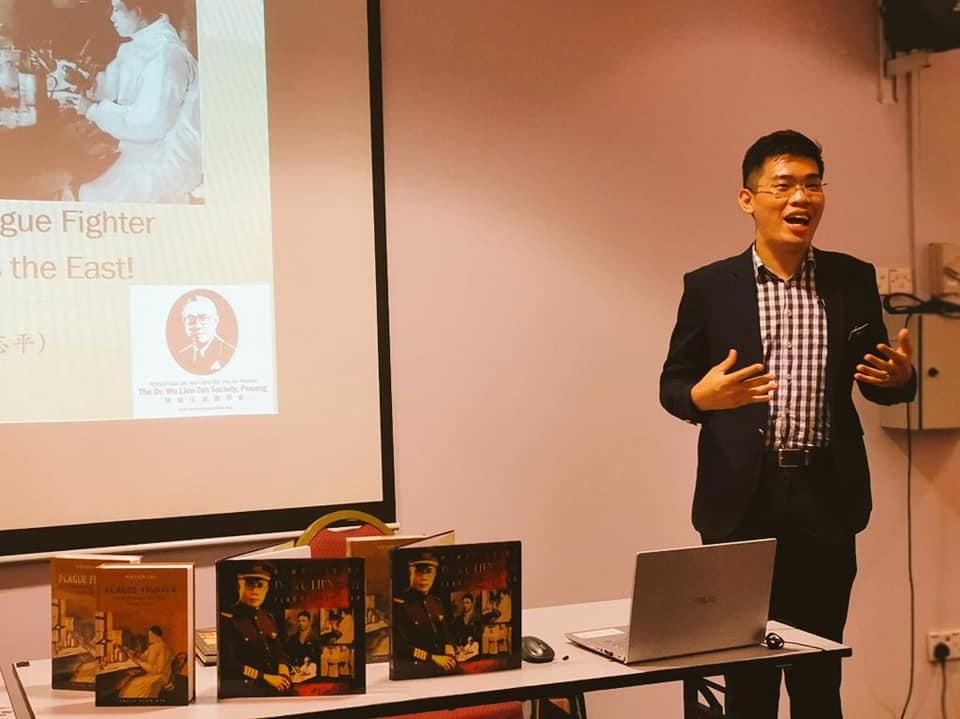
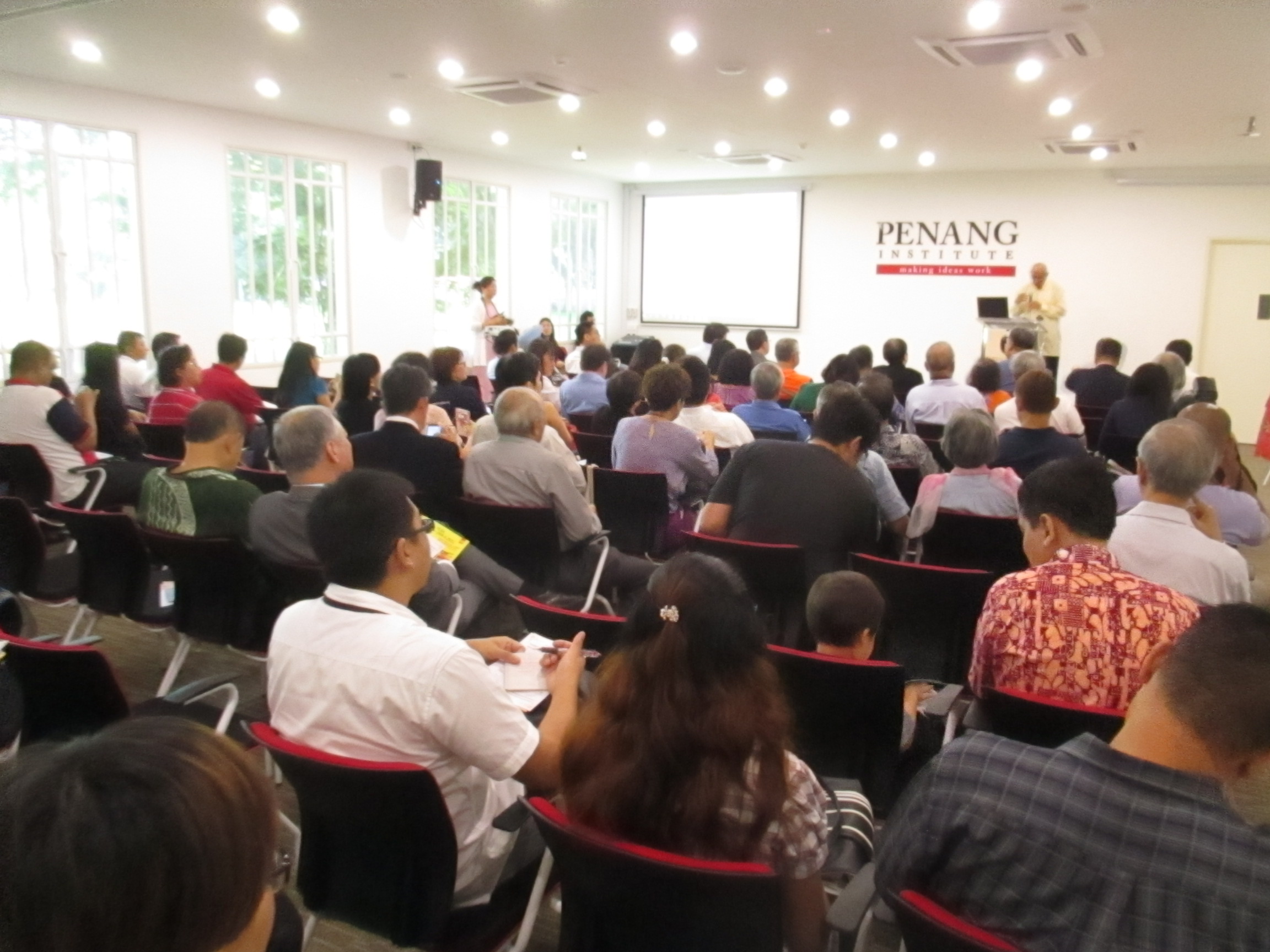
Dr Henry Chong Ren Jie (庄仁杰博士) from Centre for Malaysian Chinese Studies gave a succinct history account on Dr Wu Lien Teh (伍连德:医生与社会) in Chinese language for the morning session, while Dr Hor Chee Peng from the Dr Wu Lien-Teh Society, Penang delivered a talk on Dr Wu’s legacy and life journey (Dr Wu Lien-Teh: Plague Fighter! When the West met the East!) in English Language for the afternoon session!
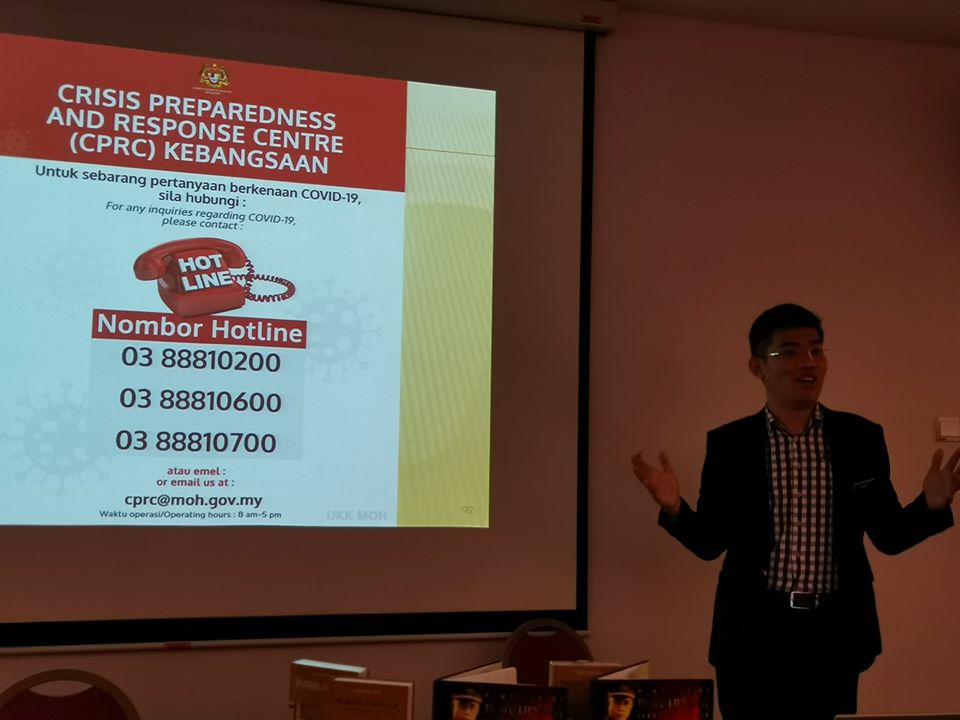
The crowd also received a brief updates on the current COVID19 epidemic, individual and community prevention! No hand shake! Hand hygiene! Cough etiquette! Don’t panic! Don’t spread fake news! And of course, some reflections on how Dr Wu’s effort in combating plague more than 110 years ago in Northern Manchurian became relevant for modern epidemics!
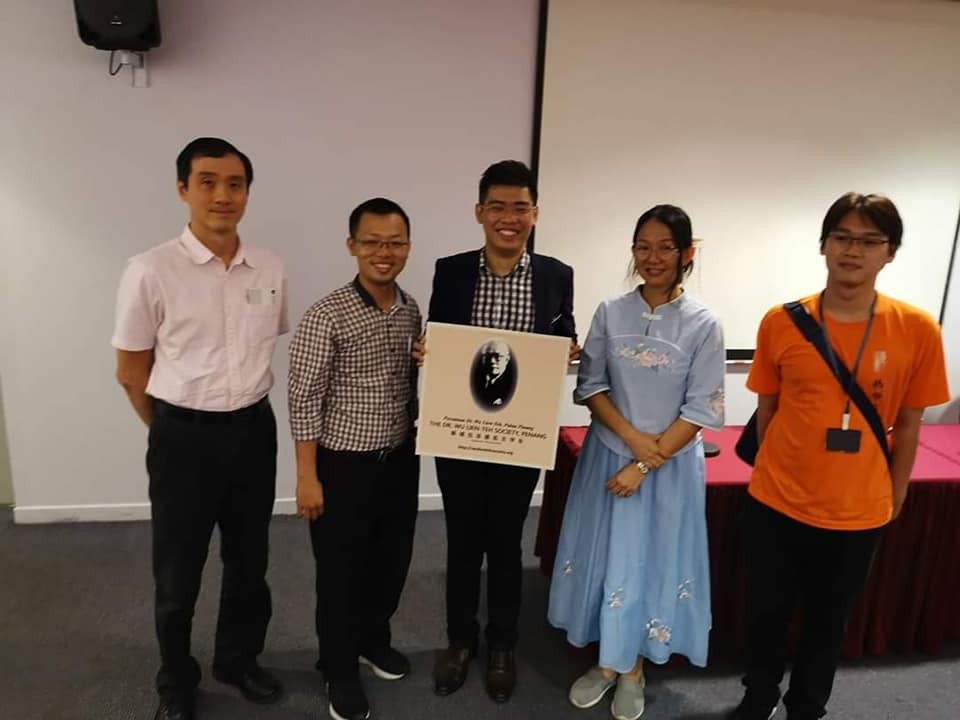
Group photos with organizers, speakers and attendees
Dr Hor Chee Peng delivers his talk to the crowd
Group photo with the organizer (Left to Right: Assistant Professor Dr Toh Teong Chuan, Mr Vincent Zyn Lan, Dr Hor Chee Peng, Assistant Professor Dr Tan Ai Boey and Mr Vincent)
Public with concerns and queries on COVID19 can contact Crisis Preparedness and Response Centre, Ministry of Health, Malaysia. No panic! No fake news!
The new way to greet and say hello, replacing the conventional handshaking!
10th March 2019 marked the 140th birthday anniversary for Dr Wu Lien-Teh, the eminent son of Penang! The Dr Wu Lien-Teh Society, Penang led by Dato’ (Dr) Anwar Fazal, organized a casual tea party with members and friends of the Society at Penang Institute. Dr Wu’s bronze stature has been relocated to the Wu Lien-Teh corner in Penang Institute, with a hut built from recycled materials. It was a great afternoon gathering among friends, exchanging ideas and plans for future activities in promoting this legendary figure! While his scientific contribution were overwhelming, much of his works for social justice requires attention and revitalization!
From 8TV Channel Malaysia: Footprints in History (9 March 2018)
GEORGE TOWN: The local mural art scene now has an extra attraction along Madras Lane here, where the historical Hu Yew Seah buildings are located.
Depicting the legendary Indian poet Rabindranath Tagore and the Penangite plague fighter Dr Wu Lien-Teh, the mural adorns the facade of SJK(C) Hu Yew Seah – one of the four buildings.
Measuring 12m in height and 18cm wide, the colourful mural commemorates the legacy of the two men, who helped lay the foundation for the buildings.
Alison Chong, the great-grandniece of Dr Wu and vice-president of the Dr Wu Lien-Teh Society, was among those who attended the launching ceremony on Saturday.
“I find that the use of colours really brings him to life.
“Hopefully, when tourists come to take photographs of the mural, they will also learn more about their legacy,” she said.
The launch of the mural, which took artist Gabriel Pitcher about 80 hours to complete, also coincided with Dr Wu’s 129th birth anniversary.
“It was difficult as the only reference photographs of them were in black and white,” said Pitcher.
School vice-president Tan Hun Chin said he wanted to have the mural painted after learning from Think City chairman Datuk Dr Anwar Fazal that the men had laid the first two foundation stones for SJK(C) Hu Yew Seah.
Dr Anwar said Tagore and Dr Wu were kindred spirits in the fight against colonialism and had championed indigenous cultures.
“Tagore, as an Indian, fought for cultures to retain their identities despite being colonised by foreign powers.
“Dr Wu battled the opium trade and racial discrimination.
“That is why Tagore was asked to lay the foundation stone for one of the Hu Yew Seah buildings in 1927 and Dr Wu did the same for the next one about a year later,” he said.
Founded in 1914, Hu Yew Seah – also known as the League of Helping Hands – was originally set up to give Chinese education to the Straits Chinese (Baba Nyonya).
Tagore, the first Asian to win the Nobel Prize in Literature in 1913, helped shape the thoughts of world leaders with his poems and writing while Dr Wu was celebrated as the “Plague Fighter” after saving masses in north-eastern China from a pneumonic plague in 1910.
Dr Wu was also the first Malayan nominee for the Nobel Prize in Medicine in 1935.
Read more at https://www.thestar.com.my/news/nation/2018/03/12/hu-yew-seah-honours-legendary-poet-and-doctor/#RF4oVd5WtKuYgozB.99
Venue: Penang Institute, 10, Jalan Brown, 10350 George Town, Penang Institute
15.30pm
Registration of participants and speakers
15.45pm
Arrival of distinguished guests
16.00pm
Welcome by Dato’ (Dr.) Anwar Fazal, President of the Dr. Wu Lien-Teh Society
16.10pm
Speech by Dato’ Dr. Ooi Kee Beng, Director of the Penang Institute
16.20pm
The 4th Dr. Wu Lien-Teh Memorial Lecture on “Virology in the Jungle: Pay Attention to What Matters to Local Communities” by Professor Mary Jane Cardosa, Founder and Chief Scientific Officer, Sentinext TherapeuticsModerator: Dr. Hor Chee Peng, Secretary-General, Dr. Wu Lien-Teh Society
17.30pm
Closing remarks by Dato’ (Dr.) Anwar Fazal, President of the Dr. Wu Lien-Teh Society
Mural paintings to commemorate Dr. Wu Lien-Teh and Rabindranath Tagore
2諾貝爾得主曾主持學校奠基 輔友畫伍連德泰戈爾肖像
These murals are to commemorate the contributions of Dr Wu Lien-Teh and Rabindranath Tagore – two prominent figures who were responsible for the establishment of Hu Yew Seah Association in Penang.
Hu Yew Seah Association runs a Chinese-language kindergarten, Tadika Hu Yew Seah, and the Hu Yew Seah Board of Managers operates the Chinese vernacular primary school, SJK(C) Hu Yew Seah, which is aligned with the original objective of the association as an institution of learning.
The painting of the commemorative murals of Dr. Wu Lien-Teh and Rabindranath Tagore was spearheaded by the Hu Yew Seah Association in collaboration with Think City, Wu Lien-Teh society, Penang Gandhi Peace Centre, Ming Art and CanCan Public Art.
The suggested size of the painting is 20′ x 10′. The figures of these two men will be painted on the wall of the main building of SJK(C) Hu Yew Seah.
“Rabindranath Tagore, the first Asian who was awarded the Nobel Prize for Literature, laid the first foundation stone of Hu Yew Seah building on 14 August 1927 during one of his voyages to Malaysia.
“Dr. Wu Lien-Teh, the internationally-renowned “Plague Fighter” who stopped the Manchurian pneumonic plague and brought modern medicine to China, laid the second foundation stone on 25 December 1938,” said Datuk Dr. Anwar Fazal who’s Think City Sdn. Bhd chairman.
The Dr. Wu Lien-Teh Commemorative Global Symposium 23 & 24 July, 2016
Speech by Chief Minister of Penang, YAB Tuan Lim Guan Eng
At The Opening Ceremony of the Dr Wu Lien-Teh Commemorative Global Symposium on 23rd July 2016
http://cm.penang.gov.my/index.php/darimejaketuamenteri/1930-opening-ceremony-of-the-dr-wu-lien-teh-commemorative-global-symposium
Penang is proud to be the home state of numerous historical greats of the country, namely P Ramlee, Malaysia’s greatest filmmaker, Loh Boon Siew, the pioneer in the automotive industry in Malaysia, Yeap Chor Ee, the banking magnate and last but not least, Dr Wu Lien-Teh, the internationally acclaimed doctor and plague fighter.
Ladies and gentleman,
Dr Wu Lien-Teh was a highly respected epidemiologist and doctor. His unyielding passion and determination as doctor together with strong perseverance have remained an inspiration for generations. His life story and heroic achievement had made all of us proud.
During his early career in Penang in early 1900’s, he was an enthusiastic activist in a myriad of contemporary social issues, ranging from advocating elementary education for girls, forming debating and literary clubs, to writing articles in newspaper calling for abolition of gambling and spirit farms. He established the Anti-Opium Association in Penang and organized the first Anti-Opium Conference in Straits Settlement to advocate banning of opium trade at times.
He was later invited to China, where he fought a challenging battle of the Machurian plague. His formulation of public health policies and institution of control measures were met with violent resistance. These measures were compulsory hospitalization of plague victims, contacts isolation, homes disinfection and people were encouraged to wear the “Dr Wu’s mask” which were uncommon practice at times in China.
He also conducted the first ever mass cremation of corpses in Chinese history which strongly against the tenets of Confucianism that venerated filial piety and ancestor worship in the past. This had led to not only saving thousands of lives by halting the epidemics.
Becoming world-famous for his outstanding achievement had never affected his innate modesty. He returned to Malaya during the turbulence time of Second World War, and continued to practice medicine in Ipoh until the ripe age of 80, before retiring in Penang.
The Dr Wu Lien-The Society was initiated in 2012 as a result of a Penang Story Lecture on Dr Wu which was organized by Think City, Penang Heritage Trust and the Old Frees Association. Led by the Founding President, Dato’ Anwar Fazal, together with support from representatives from the Old Frees Association, Penang Medical College, Harbin Medical University, Penang Institute, Penang Heritage Trust, as well as Think City and Penang Global Tourism, this initiative aims to promote this Penang-born legendary figure and to inspire the present and future generations. Since its inception, the Society has now grown its network to include several reputable institutions namely, the Malaysian National Clinical Research Centre Networks, United Nation University- International Institute for Global Health and the newly established Wu Lien-Teh Institute in Harbin, China.
Ladies and gentlemen,
The State government has been keen to support initiatives of the Society since the first Commemorative Symposium in 2014 through this 2nd Commemorative Global Symposium at Penang Institute, and the dinner tonight at the St Giles Wembley Hotel.
I am pleased to be here to witness the ceremony of signing of Memorandum of Understanding between the Society and United Nations University, International Institute for Global Health. The MOU addresses collaborative joint hosting of an annual public lecture on topic of contemporary global health importance, named as “The Dr Wu Lien-Teh Lecture”, from selecting a distinguished speaker to organizing the event. Additionally, both parties may collaborate on other initiatives related to global health importance.
It is also my pleasure to launch the first reprint of 1000 copies of the pictorial book of “Memories of Dr Wu Lien-Teh, Plague Fighter” in Penang by local publisher, Areca Books. The first edition was printed in Singapore in 1995 and out of stock. This current project received generous funding supports from Dato’ Cheah Cheng Hye, a Penang-born successful entrepreneur in Hong Kong, together with supports from the Dr Wu’s families and the Society.
The relocation and placement of Dr Wu Lien-Teh bust at Penang Institute signifies the recognition by the State Government for Dr Wu’s altruism and extra-ordinary contributions in making a difference for all.
Ladies and gentlemen,
Today, we are all here together to celebrate and honour the life of a Penang-born medical scientist who set the standard for generations of doctors to follow, and who nearly brought back a prestigious Nobel Prize in Physiology or Medicine. It is great to see a reunion of more than 30 of the family members attending this event, including the 93-year old granddaugther, Madame Tai Ai Luen. I am very confident that Dr Wu Lien-Teh Society will continue to promote the legacy of this Penang-born iconic legend. I am proud to announce the opening of the Dr Wu Lien-Teh Commemorative Global Symposium and wish you a fruitful meeting among all of you.
Wu Family Reunion in Penang 2016
visit to Dr. Wu Lien Teh’s Parents tombs at Mt. Erskine
State Dinner at St. Giles Wembley Hotel
For more details of the symposium, here is the link to the file:
Dr. Wu Lien-Teh and China’s First Medical Research Institute: The North Manchurian Plague Prevention Service, 1912–1931 Commemorating the international medical legacy of Penang-born Dr. Wu Lien-Teh Time & Date: 4pm, Sunday, 1 June 2014 Venue: Penang Heritage Trust, 26 Lebuh Gereja (Church Street) Speaker: David Luesink, Ph.D. (University of British Columbia) Visiting Assistant Professor, Department of History, University of Pittsburgh Co-organised by Penang Heritage Trust and Dr. Wu Lien-Teh Society Supported by Penang Medical College and Ren i Tang Abstract The north Manchurian plague of 1910 to 1911 is one of modern China’s most well-known medical events. Extensively celebrated in Chinese and English popular and scholarly literature, Wu Lien-teh and his small team of scientists effectively protected Qing (1910–1911) and Republican Chinese sovereignty at a time when China was extremely weak internationally. But protecting sovereignty with medical science does not constitute the whole story, nor should the story end in 1911. After successfully stopping plague in North China, Wu Lien-teh hosted an international conference in Harbin, which had been the epicenter of the plague, to demonstrate his success to leading bacteriologists from all imperialist powers with an interest in commerce, sovereignty, and the spread of disease in Northeast Asia, including Russia, Japan, Britain, France and the United States. Consolidating the growing international prestige of the plague research in Harbin, Wu Lien-teh established China’s first medical research institute. At a time when medical research institutes of this type were relatively new, this institute conducted important, if controversial, research on plague and its vectors of infection. This presentation will refocus attention away from the headlines of 1910–1911 and onto the daily work of scientists and some of the controversies they solved and created over several decades. About the speaker David Luesink is visiting assistant Professor in East Asian History at the University of Pittsburgh. He was awarded a Luce Foundation Postdoctoral Fellowship at Indiana University in Indianapolis, and before that obtained his PhD from the University of British Columbia in Vancouver. As a History Department doctoral student David Luesink was awarded two prizes for 2009–2010, namely, the Chiang Ching-Kuo Foundation Dissertation Fellowship administered by the Canadian Association of Asian Studies; and the Academia Sinica (Taipei, Taiwan) Pre-Dissertation Fellowship, Institute for Modern History. He is the author of a chapter published in an edited volume: ‘The History of Chinese Medicine: Empires, Transnationalism and Medicine in China, 1908–1937,’ in Iris Borowy, Uneasy Encounters: The Politics of Medicine and Health in China 1900–1937 (Frankfurt, New York, Oxford: Peter Lang, 2009), 149–176. Limited spaces available, to RSVP, please email to info@pht.org.my or wulientehsociety@gmail.com
Celebrating the life of the man who brought modern medical care to China, who fought the Manchurian plague, and who set the standard for generations of doctors to follow…………………..伍连德博士: 斗疫防治,国士无双